French retreat from Moscow
War and PeaceFrench retreat from Moscow marks the point at which the invasion of Russia changes from an advance sustained by momentum into a flight that progressively destroys the invading army. After reaching Moscow, the French remain there for five weeks without fighting or moving, while the city offers neither the expected political settlement nor the supplies needed to sustain them. Their departure begins not as the execution of a lucid master plan but as the consequence of accumulated material and psychological pressures. The retreat therefore has decisive thematic importance: it makes visible how armies are governed by roads, food, weather, exhaustion, fear, and the collective movement of thousands of men, even when later historians attribute every turn to Napoleon Bonaparte’s personal genius.
From Invasion to Stagnation
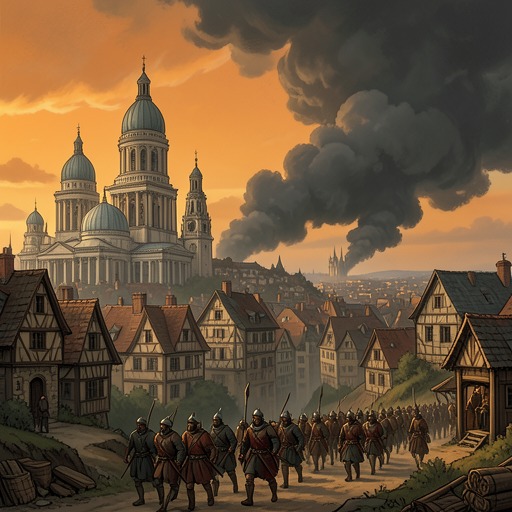
The French advance toward Moscow is described as a movement gathering force as it approaches its goal. Behind Napoleon Bonaparte’s army lay seven hundred miles of hunger-stricken and hostile country; ahead lay only a few dozen miles separating it from Moscow. Each soldier felt the attraction of the goal, and the invasion moved forward by its own momentum. The Battle of Borodino did not destroy either army, but it exhausted the force of the French advance. The Russian army withdrew eighty miles beyond Moscow, while the French continued to the city and then came to a standstill.
The five weeks of occupation expose the contradiction at the heart of the French position. Moscow had been the army’s objective, but its capture did not produce the political conclusion that the invasion required. The French did not move, and no new battle followed immediately. The army’s pause is compared to the behavior of a mortally wounded animal licking its wounds: it remains inert, not because the danger has passed, but because the violence of its previous movement has left it incapable of continuing in the same direction. The occupation is thus less a triumph than a suspension between advance and collapse.
Material Disintegration and Pillage
The French army deteriorates inside Moscow through failures that are concrete rather than abstract. Soldiers rob and pillage despite repeated orders to stop them. Marauding Guards return to the Kremlin, break into cellars and stores containing army supplies, disobey sentinels and officers, and abuse those who try to restrain them. Even the picked soldiers appointed to guard Napoleon Bonaparte’s person fail to provide the discipline expected of them. The army consumes and destroys the provisions that might have preserved it, behaving like a herd of cattle running wild and trampling the fodder that could have saved it from starvation.
This disorder is not merely a moral accusation; it has logistical consequences. The army remains in Moscow while its discipline weakens, its supplies are squandered, and its cohesion deteriorates. When the retreat finally begins, the soldiers carry away what they have stolen, adding unnecessary baggage to an already endangered movement. Napoleon Bonaparte also removes his personal treasure, while the army’s roads become obstructed by caleches and carriages filled with stolen property. Vehicles that might have carried provisions, the sick, or the wounded instead burden the retreat. The distinction between military command and uncontrolled acquisition disappears into the same movement of depletion.
The wider campaign confirms the importance of material conditions. In earlier stages, the Russian army under Mikhail Kutuzov had been forced into rapid retreat by a larger French force, hostile or unreliable populations, shortages of supplies, and conditions unlike those anticipated by the planners of the war. Russian rearguard actions at Lambach, Amstetten, Melk, and later the stand at Krems could delay the enemy, but they could not erase the effects of exhaustion, inadequate clothing, sickness, and the loss of men. The same war that had weakened the Russians through marching and hunger eventually turns those pressures with greater force against the French.
The Turn Toward Flight
The immediate impulses for the French departure are presented as a sudden panic caused by the capture of transport trains on the Smolensk road and by the Battle of Tarutino. News of Tarutino reached Napoleon Bonaparte unexpectedly while he was at a review. It awakened a desire to punish the Russians, and he issued the order to leave Moscow at a moment when the entire army was already demanding departure. The order therefore appears less as the origin of the movement than as the visible expression of a pressure that had accumulated throughout the occupation.
The retreat initially turns toward the Kaluga road, but the French soon abandon the possibility of moving through a better-supplied district. At Malo-Yaroslavets they retain the field, yet they do not secure a decisive new campaign. They retreat along a devastated road, despite the availability of another route and despite the fact that the parallel road would later be used by Mikhail Kutuzov in pursuit. The movement then continues toward Smolensk, beyond Smolensk, across the Berezina, beyond Vilna, and farther still. The sequence gives the retreat an almost mechanical quality: each stage narrows the army’s choices and makes the next stage more destructive.
The narrative repeatedly separates what commanders wished to do from what the army could physically do. After the Battle of Borodino, Mikhail Kutuzov and the Russian army believed that the battle had been a victory and prepared for another conflict. Yet reports of enormous losses made an immediate attack impossible. The wounded had to be collected, ammunition replenished, the dead counted, officers replaced, and the soldiers given food and sleep. The desire to act could not create the conditions required for action. The French retreat operates by the same principle in reverse: orders and intentions cannot restore roads, provisions, health, discipline, or the cohesion already lost.
Scale of the Collapse
The retreat’s human cost is expressed through a stark numerical reduction. After the frosts began on October 28, the French flight became still more tragic. From Moscow to Vyazma, the French army numbered seventy-three thousand men, excluding the Guards, but was reduced to thirty-six thousand. No more than five thousand of the missing had fallen in battle. The greater part of the destruction therefore came through freezing, sickness, hunger, exhaustion, desertion, and the general disintegration of the army rather than through a single decisive engagement.
From Vyazma to Smolensk, from Smolensk to the Berezina, and from the Berezina to Vilna, the army continues to melt away. Beyond Vyazma, its three columns contract into one mass, a physical sign that organized formations are giving way to a crowd seeking food and safety. Berthier reports that the corps are almost disbanded: scarcely a quarter of the soldiers remain with their regimental standards, while the rest move independently in the hope of finding food and escaping discipline. The retreat thus destroys not only numbers but the institutional form of the army itself.
At the Berezina, surrender and death divide those unable to cross from those who manage to flee farther. The supreme commander puts on a fur coat, enters a sleigh, and gallops away alone, while others who can leave do so and abandon their companions. The image completes the movement’s social reversal. The army that once advanced as a disciplined imperial instrument ends as separated individuals, each pursuing survival amid the ruins of collective command.
Historical Meaning and Narrative Form
The retreat is used to challenge the explanations offered by conventional military history. Historians describe Napoleon Bonaparte’s arrangements, the maneuvers of his marshals, and the profound considerations supposedly governing the route from Malo-Yaroslavets to Smolensk and beyond. Even the abandonment of the army by its leader is transformed into an act of heroic genius. The narrative contests this language by comparing the French army after Moscow to a wounded animal that no longer understands its own movements. Like an animal that rushes toward a hunter’s gun after hearing a rustle, the army responds to each new pressure in ways that hasten its destruction.
Napoleon Bonaparte is consequently compared to a child holding strings inside a carriage and imagining that he is driving it. The image does not deny that he issued orders; it denies that the orders alone explain the movement. The army’s retreat is produced by the relation between Napoleon Bonaparte, his officers, the soldiers, the roads, the supplies, the Russian pursuit, and the accumulated conditions of the campaign. The apparent leader is carried along by forces that he cannot master.
This argument belongs to the novel’s broader account of historical causation. The explanation of the 1812 war cannot be reduced to Napoleon Bonaparte’s ambition, Emperor Alexander I’s firmness, the Continental System, diplomatic mistakes, or any single grievance. Human beings seek an intelligible cause and seize on the first prominent will available, but the movement of the historical mass controls the wills that appear to command it. The image of a ship and the wave before it clarifies the point: the wave seems to anticipate and direct the ship, yet its movement is produced by the ship’s passage. In the same way, commands appear to govern events because they accompany events, while historical persons and their orders are themselves dependent on the conditions already moving the mass.
The French retreat from Moscow therefore functions simultaneously as a military catastrophe, a logistical study, and a formal demonstration of historical inevitability. Its repeated reversals, its delay in Moscow, its sudden flight after Tarutino, its narrowing roads, its collapsing columns, and its final abandonment of the helpless make familiar heroic explanations seem strange and inadequate. By slowing the movement into successive stages and by measuring the army’s decline in food, transport, distance, bodies, and discipline, the narrative restores the physical reality that retrospective history habitually hides. The retreat ends not with one isolated defeat but with the exposure of an entire imperial machine as a wounded, starving, self-destroying mass.